Showing 1–50 of 109 resultsSorted by latest
-
SOLD!
-
SOLD!
-
SOLD!
-
SOLD!
-
SOLD!
-
SOLD!
-
SOLD!
-
SOLD!
-
SOLD!
-
SOLD!
-
SOLD!
-
SOLD!
-
SOLD!
-
SOLD!
-
SOLD!
-
SOLD!
-
SOLD!
-
SOLD!
-
SOLD!
-
SOLD!
-
SOLD!
-
SOLD!
-
SOLD!
-
SOLD!
-
SOLD!
-
SOLD!
-
SOLD!
-
SOLD!
-
SOLD!
-
SOLD!
-
SOLD!
-
SOLD!
-
SOLD!
-
SOLD!
-
SOLD!
-
SOLD!
-
SOLD!
-
SOLD!
-
SOLD!
-
SOLD!
-
SOLD!
-
SOLD!
-
SOLD!
-
SOLD!
-
SOLD!
-
SOLD!
-
SOLD!
-
SOLD!
-
SOLD!
-
SOLD!
Kaywoodie Tobacco Pipe FAQ
Kaywoodie was a pipe from Kaufmann Bros. & Bondy, or KB&B, and it first appeared in February 1919. KB&B itself began in 1851, when the German born Kaufmann brothers opened a small pipe shop in the Bowery section of New York City and made their first pipes in its back room. The Kaywoodie name, the K of Kaufmann plus wood, soon covered a whole line of pipes, and in 1936 The Kaywoodie Company became a KB&B subsidiary with offices at Rockefeller Center. By 1938 Kaywoodie of London was operating, jointly owned with Comoy's. In March 1955, S. M. Frank & Co. completed its purchase of The Kaywoodie Company, KB&B and their sister companies, and it kept the brand going for decades after. For KB&B pipes made before Kaywoodie, see our KB&B pipes page, and for Yello-Bole, the KB&B line introduced in 1932 for briar not used in Kaywoodies, see our Yello-Bole pipes page.
Most Kaywoodies can only be dated to a period rather than a year, so collectors read several clues together. A four-digit shape number is a common sign of a pipe made before 1936, while Pipedia's shape list puts the two-digit shape number era at 1927 to 1972. A Drinkless stinger means 1924 or later, a threaded Synchro-Stem means about 1931 or later, and a "patent applied for" stamp on the stem fitting points to the years before that patent was granted. The very first Kaywoodies, from 1919 to mid 1924, have an elongated inlaid shamrock on the stem, "Kaywoodie" stamped in an arch over a cloverleaf outline with KB&B inside it, and a removable aluminum inner tube, and any shape number on them is four digits starting with 42. Line names help too, since many lines have known start dates, such as the Relief Grain in 1936, the Fine Line in 1956 and the Signet in 1968.
The Drinkless is Kaywoodie's patented stinger, introduced in 1924 to keep moisture and heat from traveling up the stem. The early Drinkless Kaywoodies from 1924 through 1931 had push bit stems. In 1931, after three years of research, Kaywoodie introduced the Synchro-Stem, a threaded screw-in mouthpiece for the Drinkless fitting, and by the mid 1930s every Kaywoodie came with it. Classic era pipes usually carry the four-hole version of the stinger, which collectors look for. Not every Kaywoodie has one: Export Kaywoodies, sold briefly from 1950 to 1955, had push bit stems, and some Oversize and Handmade pipes were made with push fittings too.
KB&B registered its inlaid cloverleaf trademarks in 1881, and most Kaywoodies carry a white cloverleaf on the stem. The color and placement can tell you the grade. In its early years the Flame Grain, which KB&B called "The Last Word in Pipes" and priced at double the Super Grain, was the only Kaywoodie with a black cloverleaf inside a white circle. Early Super Grains, cut from Grecian briar, wore the cloverleaf inlay on the shank instead of the stem. Meerschaum lined Kaywoodies, first offered in 1936, were among the highest grades and also used a black and white cloverleaf. Other grades include the Relief Grain, made from 1936 into the 1960s, and the Connoisseur, one of the top grades from 1936 to 1972.
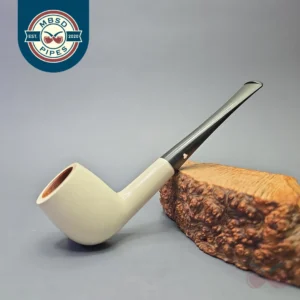
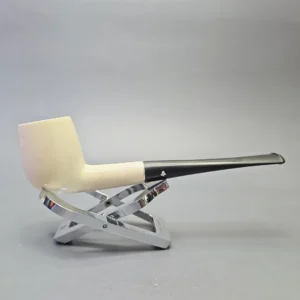
Over the years we have listed more than 100 estate Kaywoodies. The Super Grain is the line we have seen most, followed by early Drinkless pipes, Oversize and Handmade pieces, White Briars, meerschaum pipes, Rock Amberas, Silhouettes and Standards. We have also listed Flame Grain, Relief Grain, Connoisseur, Suntan, Signet, Fine Line, Natural Burl, Custom Grain, Hi-Bowl, Thorn and calabash pipes, three Pipe of the Year releases, and two midcentury prototypes. The Pipe of the Year began under S. M. Frank in 2003, with 100 pipes made each year through 2010 and 150 a year after that. The White Briar, with its opaque glossy white finish over briar, first appeared in catalogs in the mid 1950s.
MBSD lists estate Kaywoodie pipes as they come to us from pipe smokers and collectors, and about a quarter of those we have listed so far arrived unsmoked. Each one is listed with photos, measurements and condition notes, and smoked pipes are cleaned and restored first. New pipes go up on the site nightly at 9 PM ET, and availability changes, so check this page regularly. To see the week's highlights every Monday, sign up for our newsletter.
Yes, we buy Kaywoodie and KB&B pipes, from a single pipe to a whole collection. Cash offers are 50% of the current retail price, or 60% in store credit. To sell, fill out the quote form on our We Buy Smoking Pipes page. To trade toward your next pipe, use the form on our pipe trade-in page. For U.S. sellers, we can send a prepaid shipping label and deduct its cost from your quote, and we buy from sellers outside the U.S. too. Our guide on how to pack and ship a pipe collection shows how to box them safely. You will hear back with an itemized quote within 3 to 5 business days after your pipes arrive. Once you accept, payment goes out right away by check, PayPal or Zelle.
Get first look at new arrivals
Pipes sell fast. Our Monday newsletter rounds up last week's additions and previews the week ahead. One email a week, unsubscribe anytime.