
Showing all 6 resultsSorted by latest




CPF Tobacco Pipe FAQ
Get first look at new arrivals
Pipes sell fast. Our Monday newsletter rounds up last week's additions and previews the week ahead. One email a week, unsubscribe anytime.
CPF—generally identified as the Colossus Pipe Factory—is an early American pipe maker whose surviving history remains partly mysterious. Available evidence indicates that CPF was established in 1851 and had become part of Kaufman Bros. & Bondy, the company later associated with Kaywoodie, by at least 1898. The CPF name appears to have been discontinued during the mid-to-late 1910s.
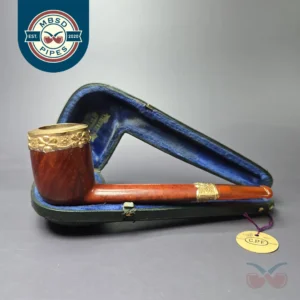
Today, CPF tobacco pipes are prized as artifacts of nineteenth- and early twentieth-century American pipe making. Surviving examples include briar and meerschaum pipes fitted with genuine amber stems, bone tenons, silver or gold-colored mounts, decorative filigree, and fitted presentation cases. Higher-grade examples may bear the “Best Make” designation and were likely intended as gifts, awards, or pipes for special occasions.
MBSD’s CPF selection consists of antique estate pipes acquired through collections and other secondary-market sources. Some examples remain unsmoked, but their age and provenance classify them as estate pipes rather than new pipes. Review each listing carefully for its estimated date, materials, nomenclature, condition, original case, and signs of age. Because amber stems and bone tenons are more fragile than modern materials, these pipes should be handled with additional care.
Showing all 6 resultsSorted by latest
CPF Tobacco Pipe FAQ
CPF is generally identified as the Colossus Pipe Factory, although incomplete historical records have led to other interpretations of the initials. What is known is that the American pipe maker was established in 1851 and later became associated with Kaufman Bros. & Bondy.
Nomenclature is one of the most useful dating clues. CPF pipes without the Kaufman Bros. & Bondy—or KBB—emblem may predate the company’s acquisition of CPF, which occurred no later than 1898. Pipes bearing KBB markings were produced afterward. Exact dating can be difficult, so construction, materials, case, and other provenance should also be considered.
“Best Make” was used on higher-grade CPF tobacco pipes. Surviving examples may feature carefully selected briar, genuine amber stems, precious-metal or plated mounts, decorative filigree, and fitted cases. These pipes appear to have been made as premium pieces, including gifts and presentation pipes.
Many CPF pipes use genuine amber stems and bone tenons, both of which are more brittle than modern acrylic, ebonite, or Delrin components. Avoid forcing or overtightening threaded connections, and support the stem close to the shank when assembling or separating the pipe. Review each listing for any age-related fissures, repairs, or material concerns.
CPF pipes are scarce antiques, so MBSD’s inventory depends on what becomes available through collections, customer trade-ins, and other secondary-market sources. Newly acquired estate pipes are generally listed nightly at approximately 9:00 p.m. Eastern Time. To sell or exchange a CPF or another tobacco pipe, visit our pipe trade-in page:
https://www.mbsdpipes.com/trade-in-smoking-pipe/
Pipes sell fast. Our Monday newsletter rounds up last week's additions and previews the week ahead. One email a week, unsubscribe anytime.


